ZuploZuplo
LoginStart for Free
  • Documentation
  • API Reference
Introduction
Getting Started
    Develop on the web portal
      1 - Setup Your Gateway2 - Rate Limiting3 - API Key Auth4 - Deploy5 - Dynamic Rate LimitingDynamic MCP Server - Quickstart
    Develop locally with the CLI
      1 - Setup Your Gateway2 - Rate Limiting3 - API Key Auth4 - Deploy5 - Dynamic Rate LimitingDynamic MCP Server - Quickstart
Concepts
Development
    CORSEnvironment VariablesBranch-Based DeploymentsTestingTroubleshootingGitOps vs TerraformCustom Code
    Local Development
    Guides
      Advanced Path MatchingAPI VersioningOpenAPI Server URLsConvert URLs to OpenAPIOpenAPI Extension DataPath Modification ScriptsOpenAPI OverlaysCanary Routing for EmployeesGeolocation Backend RoutingUser-Based Backend RoutingBypass a PolicyTesting GraphQL QueriesHealth ChecksPerformance TestingTroubleshooting Slow ResponsesNon-Standard PortsHandling FormDataS3 Signed URL UploadsCheck IP AddressLazy Load ConfigurationSharing Code Across ProjectsBackstage IntegrationGitHub Action Automation
Policies
Handlers
API Keys
Rate Limiting
MCP Server
MCP Gateway
AI Gateway
Developer Portal
Monetization
Deploying & Source Control
Analytics
Observability
Networking & Infrastructure
Account Management
Programming API
Build with AI
Zuplo CLI
Migration Guides
Platform LimitsSecuritySupportTrust & ComplianceChangelog
powered by Zudoku
Guides

Handling FormData

Zuplo supports working with FormData including multipart/form-data. In this simple example we show how you can parse a multipart entry and read the stream into memory for use in the Zuplo runtime.

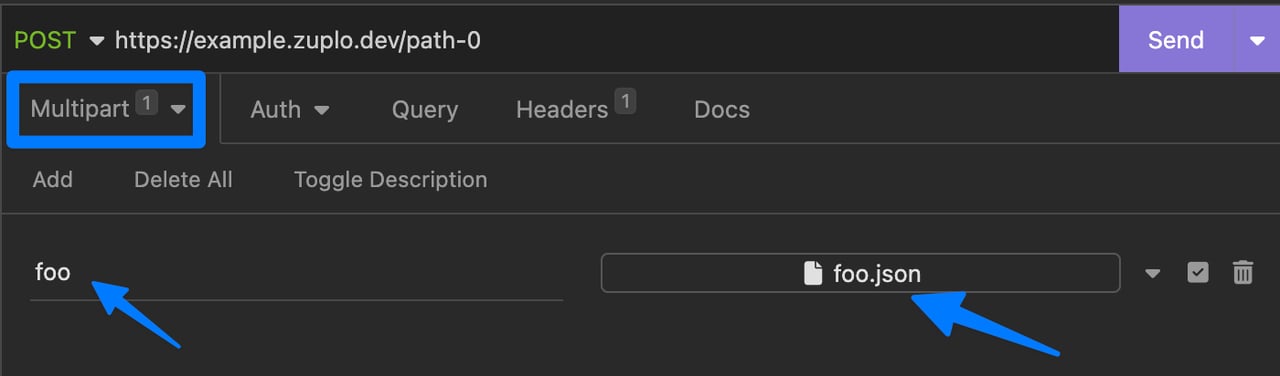
In this case, we upload a JSON file as a multipart/form-data entry using Insomnia, with a key foo

Insomnia multipart/form-data

We can then handle this programmatically inside Zuplo using a function handler. We also modify the JSON before forwarding on to the target backend server.

Code
import { ZuploContext, ZuploRequest } from "@zuplo/runtime"; // FormData can return different types in different circumstances // use this function to convert both to strings async function readFileOrStringContent(data: unknown) { if (data.constructor.name === "File") { return await (data as File).text(); } return data as string; } export default async function (request: ZuploRequest, context: ZuploContext) { const formData = await request.formData(); // read the form-data entry as a 'Blob' type const blob = formData.get("foo"); // stream the body into memory const json = await readFileOrStringContent(blob); // parse the JSON document const object = JSON.parse(json); // Modify the document somehow before forwarding on to the backend object.newKey = "newValue"; // Make a standard POST to a backend with a JSON body const response = fetch("https://backend-origin.com/example", { method: "POST", headers: { "content-type": "application/json", }, body: JSON.stringify(object, null, 2), }); return response; }
Edit this page
Last modified on November 17, 2025
Non-Standard PortsS3 Signed URL Uploads
TypeScript