
Zuplo Changelog
We release improvements, new features, and fixes daily. Follow along here to see the most important updates.
This release introduces new logging integrations with New Relic and Splunk, fixes several issues with the CLI and runtime, and improves documentation for fine-grained authorization policies.
New Features 🎉
- Added New Relic logging and metrics plugin - Enable comprehensive observability by sending logs and metrics to New Relic for monitoring and analysis
- Added Splunk log transport - Stream your API logs directly to Splunk for centralized log management and analysis
Bug Fixes 🐛
- Fixed excessive error logging in rate limiter - Rate limiter failures no longer generate unnecessary error logs, reducing log noise
- Fixed typos in CLI OpenAPI merge functionality - Corrected command syntax issues that prevented proper OpenAPI specification merging
- Fixed tunnel list command authentication - The
tunnel-listcommand now properly supports the updated authentication mechanism - Fixed AWS Lambda handler query string handling - Multi-value query strings are now correctly parsed and passed to Lambda functions
Documentation 📚
- Added documentation for Fine-Grained Authorization (FGA) policy - Learn how to implement fine-grained access control using OpenFGA
Other Changes 🔄
- Added build script to Zudoku template - The developer portal template now includes a build script for easier deployment
- Fixed API quota documentation - Updated quota configuration examples and clarified usage limits
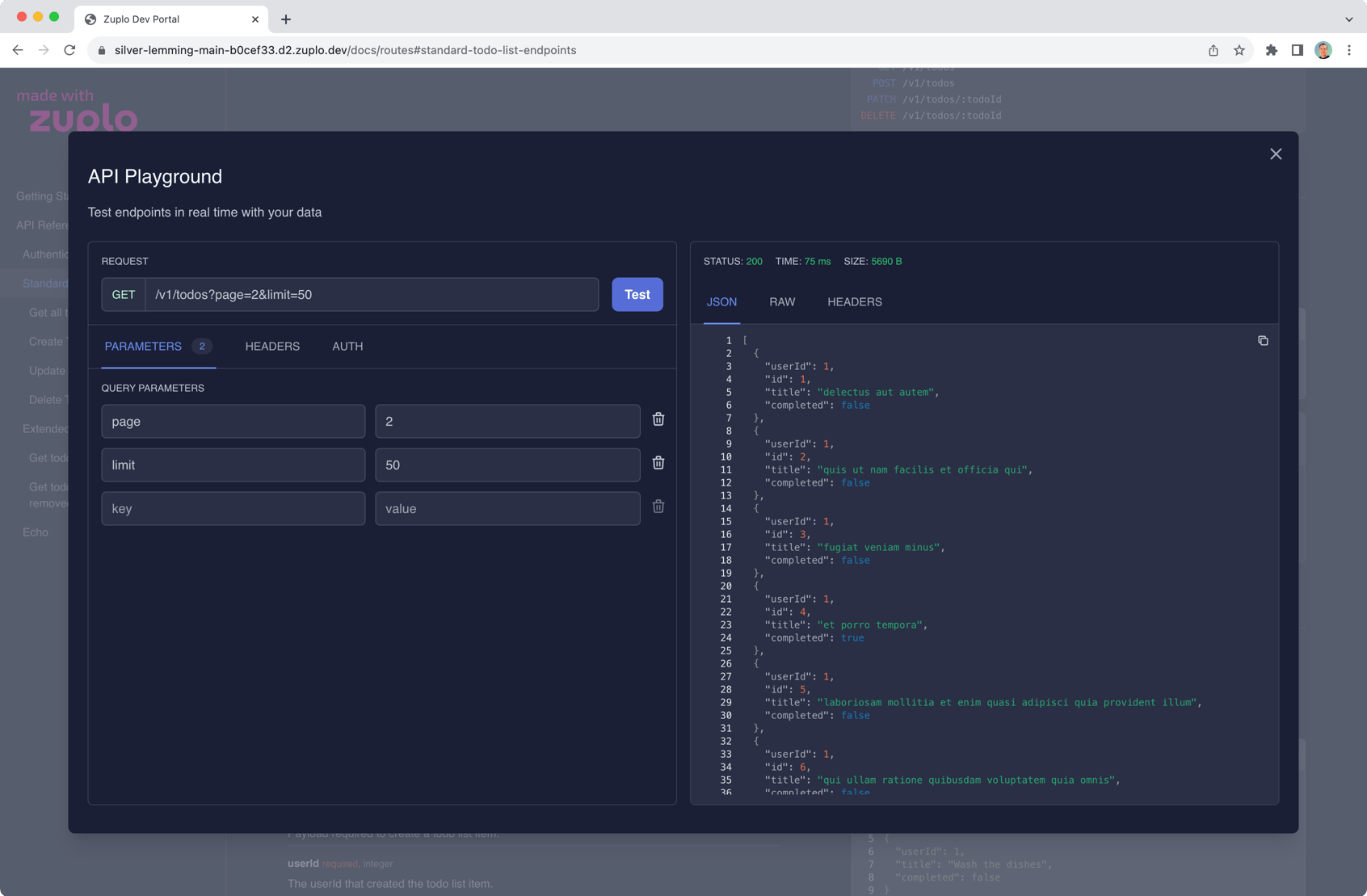
The Zuplo Developer portal is the easiest way to create beautiful documentation for your API - today, it gets even better with a new API Playground. The API Playground allows your users to immediately call your API without leaving the browser. Try it out now on Zuplo's API docs or create your own in the Portal.
We announced last week during Supabase Week that the Zuplo Developer portal now supports Supabase Authentication in addition to OpenID based auth. Supabase developers can now use their custom hosted Supabase login experience to authenticate users to their API docs hosted by Zuplo. For full instructions see the documentation.
Dev Portal Performance
Over the past several weeks we have worked on improving the overall performance of the Developer Portal and we are happy to report that the results have been meaningful. For most real use loads of the API page, the content loads in about a second. Larger APIs (i.e. with larger OpenAPI documents) may experience a bit longer load time, but we plan to address that soon.
Custom pages should load almost instantly now as we have optimized serving them from our edge CDN.
Overall you should see much snappier UI in the developer portal. We have more work to do - in particular for customers with larger OpenAPI documents, but we hope you will be happy with the recent improvements.
Over the past several weeks we have worked on improving the overall performance of the Developer Portal and we are happy to report that the results have been meaningful. For most real use loads of the API page, the content loads in about a second. Larger APIs (i.e. with larger OpenAPI documents) may experience a bit longer load time, but we plan to address that soon.
Custom pages should load almost instantly now as we have optimized serving them from our edge CDN.
Overall you should see much snappier UI in the developer portal. We have more work to do - in particular for customers with larger OpenAPI documents, but we hope you will be happy with the recent improvements.
Users of the Zuplo Developer Portal can now see analytics for their own API key usage.
Developer portal has been updated for improved performance and better error handling. Documentation improvements.
Environment Variable API + CLI
Environment variables can now be managed via the Zuplo CLI or the Developer API